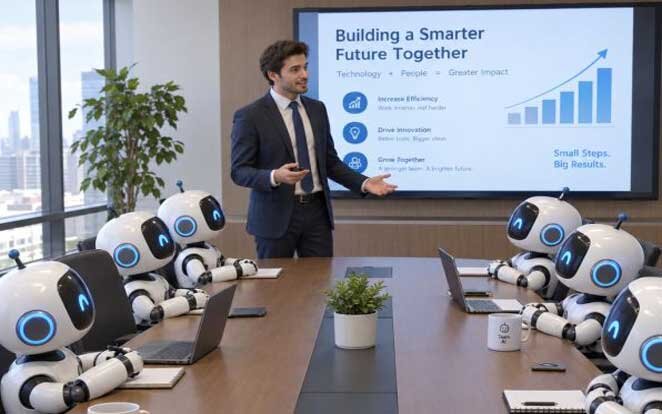
More than a year before the OpenClaw explosion, I told a group of about 40 I-O psychologists that agents would proliferate. You wouldn’t use one agent to tackle a problem, you’d use many, and their numbers would grow exponentially. I explained that they would evolve into agents designed with narrow skill focus that would function something like the brain, with an orchestrator (prefrontal cortex) controlling the communication between agents to some extent. Well, here we are. Welcome to the event horizon of the singularity?
What this means for the future of work
Organizations will need workers who combine:
- Deep expertise in at least one area (e.g., HR)
- Openness to change (flexible)
- The ability to communicate and work with other humans
- The organizational skills of a project manager
- The logic of a programmer
- I also want to add “analytical” to the list because 1) that’s my bias, and 2) workers already, or soon will, need to communicate with a team of agent analysts.
This combination of skills is going to be the target, and there’s already a shortage in many professions.* Demand for these skills will only increase as the number of tasks AI masters grows.
Agents are swarming
Companies are using agents not only for tasks tied to the bottom line, but also to map and take over any viable tasks [1] [2]. LLM abilities have improved rapidly across the board over the last couple of months, which makes this a far more viable route for many organizational tasks. Higher model IQ means handling more complex tasks (same as humans?). Companies are also realizing how much data matters for reaching these goals, so they’re amassing vast amounts of data on employees doing their jobs [3].
Final thought for today
New architectures (e.g., harnesses) and the rollout of more compute have produced a new set of tools that are evolving at a faster and faster rate. Even if LLM development slows down, the efficiencies being built right now could cause seismic shifts in how work is accomplished.
Next up: Robots are coming!
- AI generated references: In IDC’s 2026 Global IT Skills Survey, only 31% of IT leaders said their organizations were ready for AI, citing a lack of AI skills as the biggest blocker. IDC also found that leaders rank analytic judgment as the single most essential skill for working with AI, and that orchestration skills are getting harder to find. Meanwhile, the World Economic Forum’s Future of Jobs Report 2025 ranks analytical thinking and flexibility as employers’ top two core skills, and both are expected to grow in importance over the next three years.