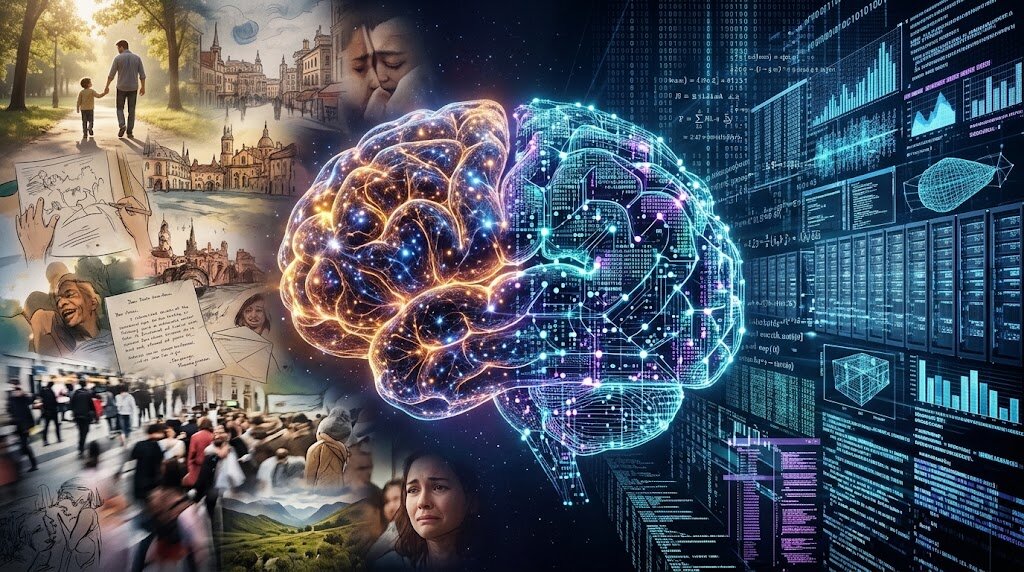
You’ll get the most confident answer to this question from a recent doctoral graduate. From someone who has studied it for a lifetime, you’ll get either a complete mish-mash or a noncommittal shrug. The theoretical landscape of intelligence has a rich and interesting history, but our current models are shifting toward broader, more neurologically based ideas as constructs are mapped to physical phenomena (e.g., brain activity). I call this the inward approach to understanding human behavior.
Then there’s the outward approach. Those with access to large datasets of humans making decisions are also reshaping their predictive understanding of human decision-making (aka problem solving, aka intelligence), and they’re moving much, much faster. Under both approaches, the definition is a moving target.
The difference between personality and intelligence
What many psychologists call personality is a mathematical model derived from language-based assessments of behavior. Personality is part of decision making, or perhaps its result (a reinforcement loop). I say “result” because personality is a mind-representation of something we can’t fully understand, much like math; it’s just an abstraction layer or two above math. It represents a pattern of behavior and decision-making built from mathematical clusters of question responses from large numbers of people. Researchers are now viewing personality as overlapping with constructs traditionally called intelligence. It’s a tangled web, because the mind originates from an incredibly complex tangle of neural networks.
The average human brain has roughly 100 trillion neural connections, while the largest LLMs have around a trillion parameters (a loose comparison). Yet AI can perform amazing feats of problem solving. It can do so because of the sheer amount of experience available in its training data, and because it has only a limited type of intelligence. My perspective is that personality matters when it comes to human decision making, problem solving, and more.
The brain doesn’t have constructs; it creates them.
Think of the brain as the physical structure and the mind as its output, result, or manifestation. While our understanding of the brain is growing, our understanding of the mind is much, much less evolved. AI as we know it, in the form of LLMs, has a brain and possibly a mind (far too deep for this conversation), but neither can function like or effectively emulate the human mind… yet. That’s not to say AI won’t build the next generation of intelligence, something we mere mortals can’t fathom.
How soon could that happen, given the pace of change we’re seeing right now? I think very soon barring a catastrophic or monumental event. For example, imagine a tech announcement that we no longer need computer chips, that a new process (biological computing?) can far exceed state-of-the-art LLMs at a thousandth of the cost. I know this sounds extreme. It is, and this exact scenario most likely won’t happen. But something is going to happen, and my wild-ass guess is that there’s a 90% chance it happens within the next 2–3 years if LLMs are allowed to keep progressing.